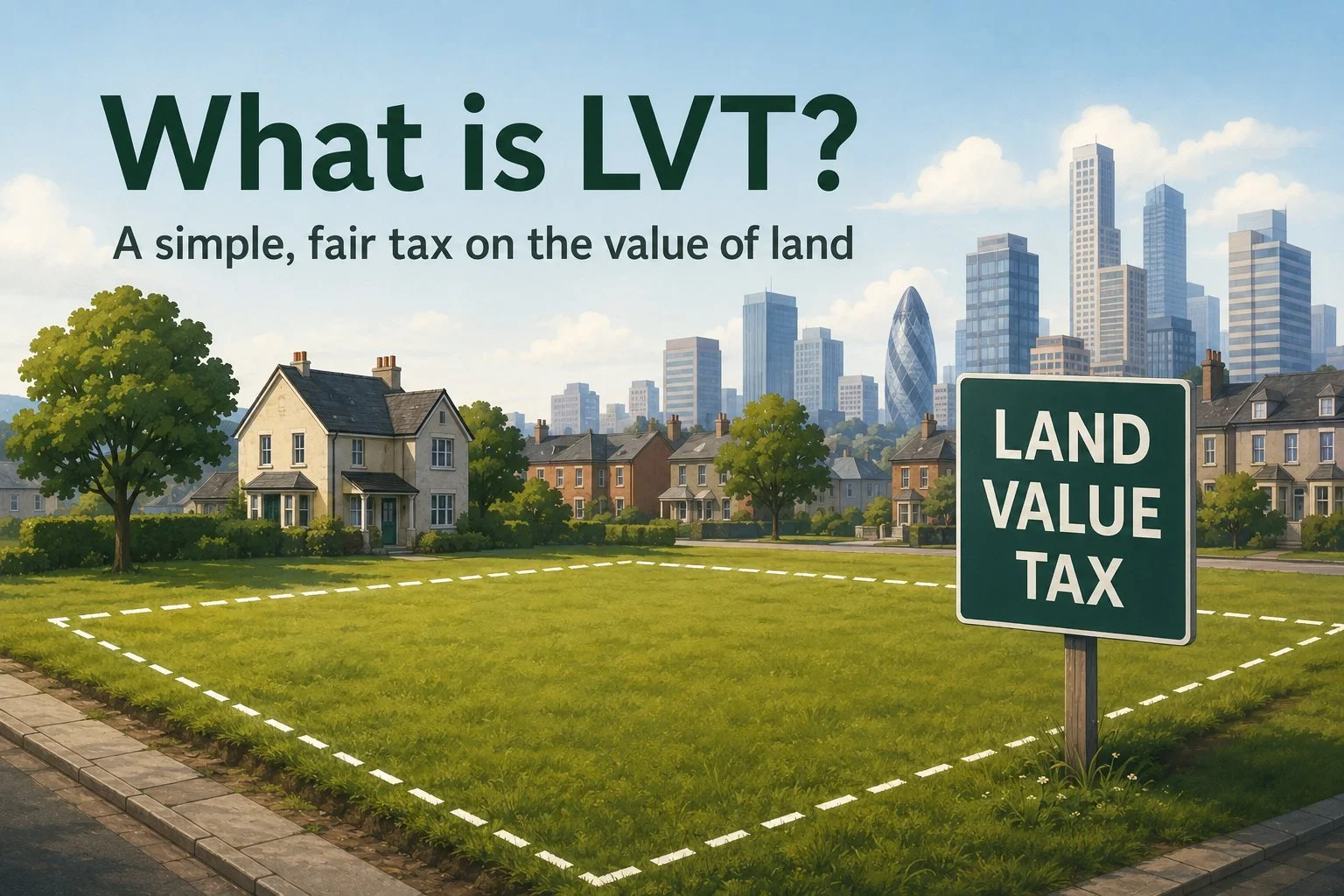
What is LVT?
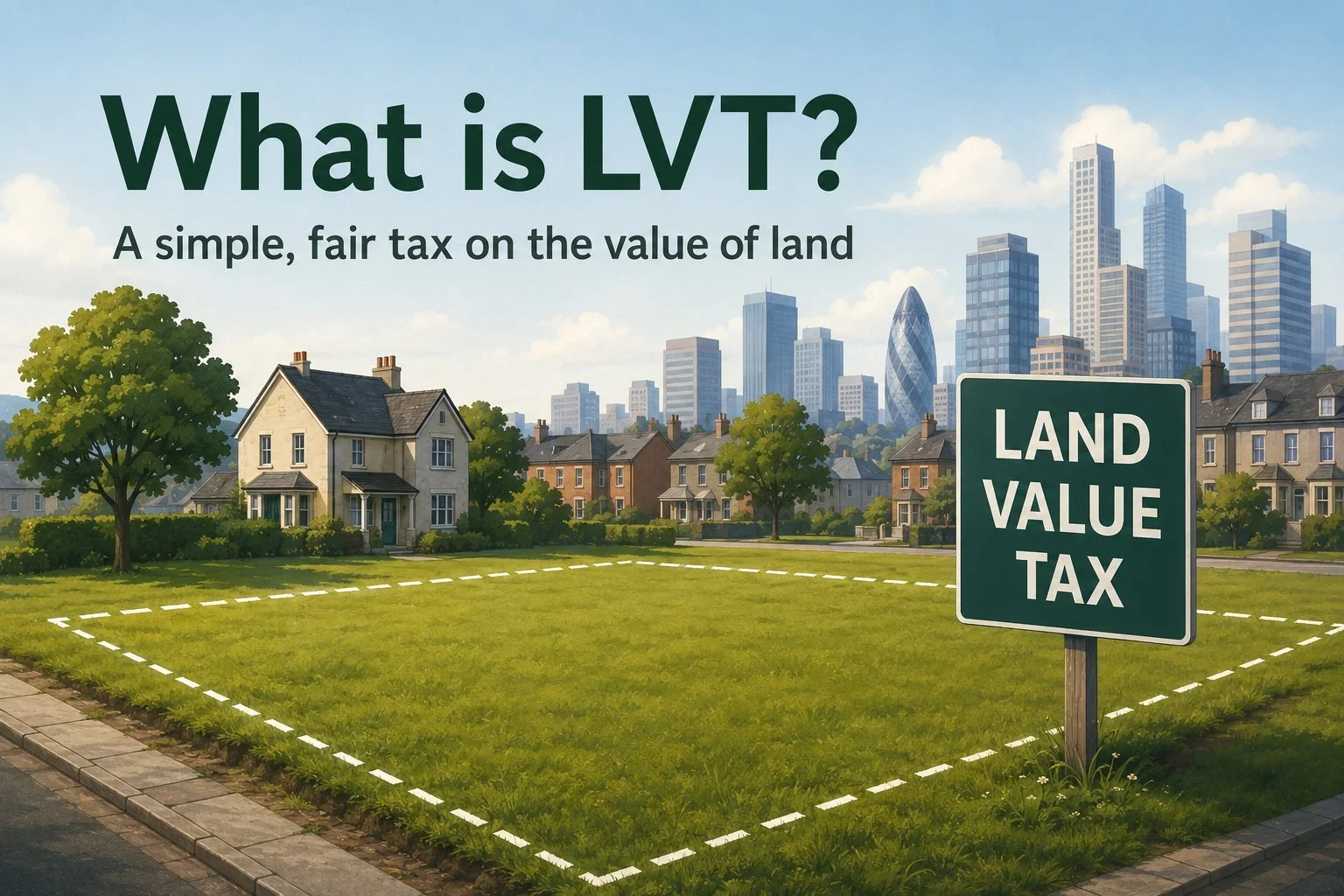
Land Value Tax (LVT)
LVT is:
an annual: the rate is set each year and the tax is collected each year,
nationally determined: the rate is set nationally not locally.
nationally collected: LVT is collected by HMRC, not by 296 councils,
percentage tax: the rate (e.g. 0.7%) is the same everywhere,
paid by the freeholder: not by tenants, lessees or “occupiers”,
on the open market value: value is what someone would pay for it.
of all land: every square inch, everywhere, no matter who holds it,
with no exceptions: there are no exceptions, for anyone, anywhere.
Land makes up over 60% of our national wealth (£7 trillion out of £12 trillion).
As a society we own it all through “the crown”.
As a society we control its use through the planning system.
As a society we should all benefit from it.
Our tax system
Politicians and others confuse spending with taxation
Spending is money created by the government and put into the economy for things we need and to invest in the future
Taxation is money taken out of the economy by government to prevent inflation. It makes sense to take it out in the fairest way possible - like Land Value Tax.
Despite what the media insists, tax does not pay for things. After all, if the government didn’t create money and inject it into the economy, there would be no money to pay taxes! Money can’t come from anywhere else!
See our article “Neoliberalism, MMT and LVT” if you still believe tax pays for thing.
The UK tax code (law) is the largest and most complex in the world. For more details see “Simplify our tax system” in our article “LVT can’t solve everything”.
The confusion of spending with taxation results in thousands of exceptions (“loopholes”) in our tax laws – ways to get out of paying tax. A whole industry of tax advisors and lawyers has grown up to advise people on how to avoid tax. A system than cannot be understood by non-lawyers is a bad system.
If we, as a society, wish to support specific things we can do so through spending decisions, If we wish to support farmers to ensure food security and to protect our countryside we can do so by providing subsidies or grants – we don’t need to create tax exceptions. If we wish to support charities we can do so with grants, not with tax exceptions.
Golden rule: never confuse spending (outgoing) with taxation.(incoming).
Good laws should be siimple to understand, fair on everyone and impossible to avoid.
Land Value Tax is such a law and can be used to replace other bad laws.,
Key points about LVT
LVT is not a new tax. It is a replacement tax (see note 1).
LVT is a tax on the value of land, not on land itself (see note 2).
LVT does not tax things on the land: buildings, gardens etc.
All land has value, even if that value is zero (see note 3)
Value depends on location and permitted use (see note 4).
Land cannot be hidden or placed in a Swiss bank account.
Freeholders pay the LVT, not leaseholders or tenants.
Freeholders are identified by the Land Registry (see note 5).
Non-payment will result in a charge on the property – it cannot be sold until all LVT is paid.
LVT applies to all land in the country and to all land held elsewhere by UK citizens (see note 6).
Land will be valued by the Valuation Office Agency (VOA), part of HMRC (see note 7).
It will be possible to appeal against valuations (see note 8).
Payment of LVT may be deferred in case of financial difficulty (see note 9).
A two year preparation period will determine land values and which taxes to replace.
LVT will be phased in over ten years to allow people and the property market to adjust.
LVT will be collected nationally (see note 10).
Local authorities may add supplements to the LVT rate (see note 11).
There are no exception to LVT, none.
Each country in the UK will make its own decision about LVT.
Notes:
Initially it is proposed that LVT replaces Council Tax and Business Rates. It is a political decision as to which taxes LVT replaces. It seems fair that LVT is used to replace taxes that fall heavier on those with lower incomes than those with higher incomes or taxes than are unfairly distributed across the country – Council Tax for example.
LVT is not based on land area, it is based one the value of land – excluding anything on the land – buildings, gardens etc. “Open Market Value” is what it would fetch at an auction if it came up for sale. There is more about “The value of land” below.
Some land has zero value because it cannot be sold and it generates no income – it would therefore pay zero LVT. For example: National Trust land that is not rented for farming, Sites of Special Scientific Interest (SSSIs), nature reserves, non-toll roads etc.
An acre of land with planning permission to build eight top quality, low density, homes in London would have much higher value than a similar acre in Gateshead. Without planning permission the land would have a much lower value. Value depends on location and permitted use.
The Land Registry records the freeholders of all land in the country – not matter where the freeholder is located in the world.. At the moment it is about 90% complete – the remainder being mainly infrastructure and the few freeholders who have not yet registered. The register will be completed before LVT is introduced.
The largest landholder in Scotland is Danish and he pays LVT to Denmark because Denmark uses LVT. UK citizens living abroad pay Income and other taxes on their UK earnings and UK pensions. Living abroad does not remove your responsibility as a citizen to pay UK tax. To prevent double taxation locally paid property taxes may be deducted from LVT due in the UK.
The VOA has been valuing land for over 100 years and has, on several occasions, valued all land in the UK. Its current responsibilities are valuing property for Business Rates and placing new build homes into Council Tax bands.
Anyone can obtain land valuations from two independent Royal Institute of Chartered Surveyors (RICS) land valuers and then appeal to a Valuation Tribunal if the value is lower than the VOA assessment. RICS has disciplinary procedures and surveyors who fail to provide reports, or provide incorrect reports, will be struck off and, in the case of fraudulent reports, further action will be taken by HMRC. Experience in other countries, Germany for example, shows that there is a small flurry of appeals when assessments are first published then these die away to almost zero as people and the market adjust afterwards.
People are already paying Council Tax. In the minority of cases where LVT is higher than Council Tax, and if the freeholder genuinely cannot afford the difference, the balance can be deferred, with interest, until the land is next sold or transferred. No one will lose their home because of LVT.
This will free up resources in the 296 local authorities in England who currently collect Council Tax and Business Rates. If LVT replaces Council Tax and Business Rates the income will be provided to local authorities to meet the full cost of their legal obligations: waste disposal, street cleaning, roads, social care, children’s services, SEND, education, public heath, trading standards, planning, parks maintenance, housing, etc. This in itself will rectify the problems (potholes, social care, etc.) caused by a real-term cut of 40% in LA spending since 2010.
Local Authorities may wish to do things beyond their legal obligations: capital investments, concerts, festivals, etc. They may also wish to discourage certain activity in their area: second homes, holiday lets, airbnbs, etc. With the agreement of their local voters they can add a supplement to the LVT rate. This will still be collected nationally but returned in full to the LA.
Cross party support
There have always been supporters of LVT in all political parties, from the right and from the left. The one thing that unites them is the essential fairness of LVT.
Why should someone gain for doing nothing simply because society grants permission for something that increases the value of their land? That something could be a railway, a tube line, a solar farm, or a housing development etc. People are morally outraged at the windfall created “while the landlord sits still” and “renders no service to the community” – as Churchill said.
Winston Churchill (who no one could call a socialist and whose family held extensive landholdings) spoke passionately in support of LVT in parliament on July 17th, 1909. You can download the entire speech but one paragraph gives the flavour – though the language is very much of its time.
“Roads are made, streets are made, services are improved, electric light turns night into day, water is brought from reservoirs a hundred miles off in the mountains – and all the while the landlord sits still. Every one of those improvements is effected by the labor and cost of other people and the taxpayers. To not one of those improvements does the land monopolist, as a land monopolist, contribute, and yet by every one of them the value of his land is enhanced. He renders no service to the community, he contributes nothing to the general welfare, he contributes nothing to the process from which his own enrichment is derived.”
Churchill and others who supported Land Value Tax in 1909, were shouted down by major landholders who were very dominant in parliament at the time – especially in the House of Lords. The intervention of WW1 meant that the subject was pushed to one side – for 117 years!
The value of land
The “open market value” of anything is what someone would pay at auction if it came up for sale.
The value of land depends on two things:
Where it is. Land in the South East has a higher value than land in the North East. Arable land in East Anglia has a higher value than hill land in North Wales.
What it may be used for. Our planning system determines this. In England, in 2026, agricultural land, depending on its quality, changes hands at between £6,000 and £17,500 an acre. Land with planning permission for homes changes hands at between £250,000 and £5 million (or more) an acre.
These two interact. An acre of land for homes in London may sell for £5 million – perhaps £10 million in the central zone. In the North East it might be £400,000 an acre.
The value of land for a new development is easy to assess – it is what the developer paid the landholder. Divide this by the number of homes per acre (40 on average in England) and you have the value of land under each home. If a developer in Gateshead paid £600,000 an acre, the value of land under each home would be £15,000. If a developer in Hertfordshire paid £2 million an acre the value of land under each home would, be £50,000.
The value of land under existing homes is the answer to this question:
“Given where it is, what would someone pay for this plot of land if there was nothing on it but it had planning permission to build what is currently on it?”
The Valuation Office Agency (VOA) can provide an assessment of land value because it maintains a record of property and land sales to compare sites of similar sizes in similar areas. Local land agents and RICS surveyors can do the same thing so anyone can appeal against a VOA assessment at a Valuation Tribunal by obtaining valuations from two independent RICS surveyors.
Click the image below for a larger version

Simple, fair and impossible to avoid
Simple
LVT is easy to understand - a percentage tax on the value of land.
The value of land depends on where it is and what it can be used for.
Fair
LVT can replace unfair taxes like Council Tax.
The LVT rate is the same everywhere: x% in Gateshead, x% in Surrey.
Those with the most, contribute the most.
Impossible to avoid
The UK tax gap, the amount that should be paid but isn’t, is currently £59.2 billion.
To put that in perspective:
An average primary school costs about £8 million to build.
An average doctor’s surgery costs about £4 million to build.
The average nurse’s salary is about £40,000.
So, in one year, if we recovered all the tax avoided, evaded and lost, we could afford:
7,400 primary schools or
14,800 doctor’s surgeries or
1,480,000 nurses
Land Value Tax is impossible to avoid – allowing us to invest in the things we need,
LVT and austerity
“Austerity” is not forced onto politicians, there is no “Big Economic God In The Sky” telling them what to do. There is no one to blame for their negative choices.
Austerity is a conscious and deliberate political choice:
not to invest in the economy.
not to make people’s live better
not to do anything about the list shown above.
not to rectify the unfair distribution of wealth in our country.
to look at the economy in the wrong way.
to side with powerful, the rich and their media.
to make the 1% even richer.
Making the economic wheels go round
We (society, the government) are the largest employer and investor in the country. “We” are the public sector.
In one way or another every private company relies on the public sector. Nurses, doctors, teachers, LA employees, armed forces personnel, civil servants etc. buy things made or sold by the private sector. National and local government are the largest customers for companies providing products and services under contract Even the City of London and the “financial sector” rely on the government to provider a secure way to store cash – government bonds – the most secure savings bank there is.
Government spending makes the economy tick - it makes private companies profitable. Without it private companies would have no customers
“We”, and public sector spending in our name, are the economic oil that makes the wheels go round! Remove the oil and the wheels grind to a halt - as they done!
Failure to invest nationally, and failure to provide Local Authorities with the funds required for local services, explains why our country looks the way it does - pretty seedy - potholes in roads and litter everywhere. Stephen Graham (the actor who seems to be in everything these days) live in Ibstock and recently said “I love England. It’s going to the shit a bit, but I love the people in this country.” A pretty sound analysis - a people let down by pusillanimous politicians.
LVT:
replaces unfair taxes, including Council Tax.
enables us to invest in the services we need.
begins to solve our unfair distribution of wealth.
makes austerity unnecessary.
Please see the article: “A fairer economy for all”.
Addressing concerns
Obviously there will be concerns about the impact of LVT, particularly in areas of high land values. Methods of minimising the impact are covered in the “Preparing for LVT” article.
LVT in a nutshell
The key points behind LVT are covered in this short presentation - which has no sound.
Please view in full screen landscape.
Facts about land

Land is under our feet - under our homes, our fields, our rivers, our lakes, our roads, our offices and our factories
"Land" is a defined area of the Earth's surface.
“Property” is a combination of land and everything on it: buildings, plants etc.
Land is a national asset - it accounts for over 60% of our national wealth: £7 trillion out of almost £12 trillion.
The job of government is to use our national assets for the benefit of us all.
We own it and we control its use - but we get nothing in return - there is no tax on land.
50% of the land in England is held by 1% of the population.
30% of the land is held by the Aristocracy (Monarch, Dukes, Marquesses, Earls, Viscounts, Barons).
5% of the land is held by home owners.
71% of land in England is used for agriculture.
46% of all agricultural land in England is farmed by tenants paying rent to landholders.
Fewer than 300,000 people work in agriculture - about 1% of the workforce.
Council Tax is a tax on homes and gardens - the land and everything on it.
A £54 million house in Westminster pays less Council Tax than a £260,000 new build in Gateshead.
The unusual case of Anders Povlsen
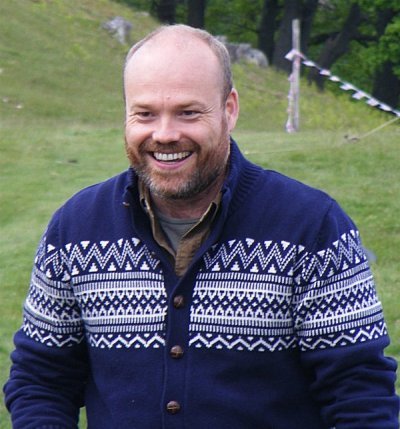
This is the Danish billionaire Anders Povlsen
Anders built up the worldwide Bestseller retail chain.
Anders holds over 220,000 acres of land in Scotland.
Anders is committed to environmental protection and wildlife introduction.
Anders pays LVT on his land in Scotland.
The LVT goes to Denmark, not to Scotland.
Denmark uses LVT, Scotland doesn't.
Danish families benefit from LVT paid on Scottish land.
Denmark publishes maps of who holds land and it updates those maps every day!
Is there any reason why we don't do the same?

Ferne Park
Jonathan Harmsworth, the tax avoiding owner of the Daily Mail, is a nom-dom, he is not resident in the UK for tax purpose. His residence is Ferne Park in Wiltshire - shown at the top of this page. As well as Ferne Park Jonathan holds 4,700 acres of the Bryanston Estate in Dorset which he purchased from the crown estate in 2015. The estate is legally held in the name of Bryanston (RFE) Ltd whose shareholders are based in Jersey. Jonathan’s Harmsworth Trust Company (PTC) Ltd is based in the British Virgin Islands tax haven.
Jonathan’s “newspaper” describes Land Value Tax as a “garden tax” because Jonathan does not want to pay tax on his 4,700 acre “garden” - he prefers to take rent from his farming and other tenants. Like many so-called “patriots”, Jonathan goes out of his way to avoid his social responsibilities by finding every possible way to avoid tax. We have no wish to be sued by the Daily Mail so we are not suggesting that Jonathan is a liar and hypocrite.
In 2024/25 Jonathan paid £4,452 Council Tax (a tax on homes and gardens) in Band H. In Gateshead a Band H property (if there is one) would pay £4,901.
Jonathan’s family has a long history of avoiding tax as well as some unfortunate political affiliations.