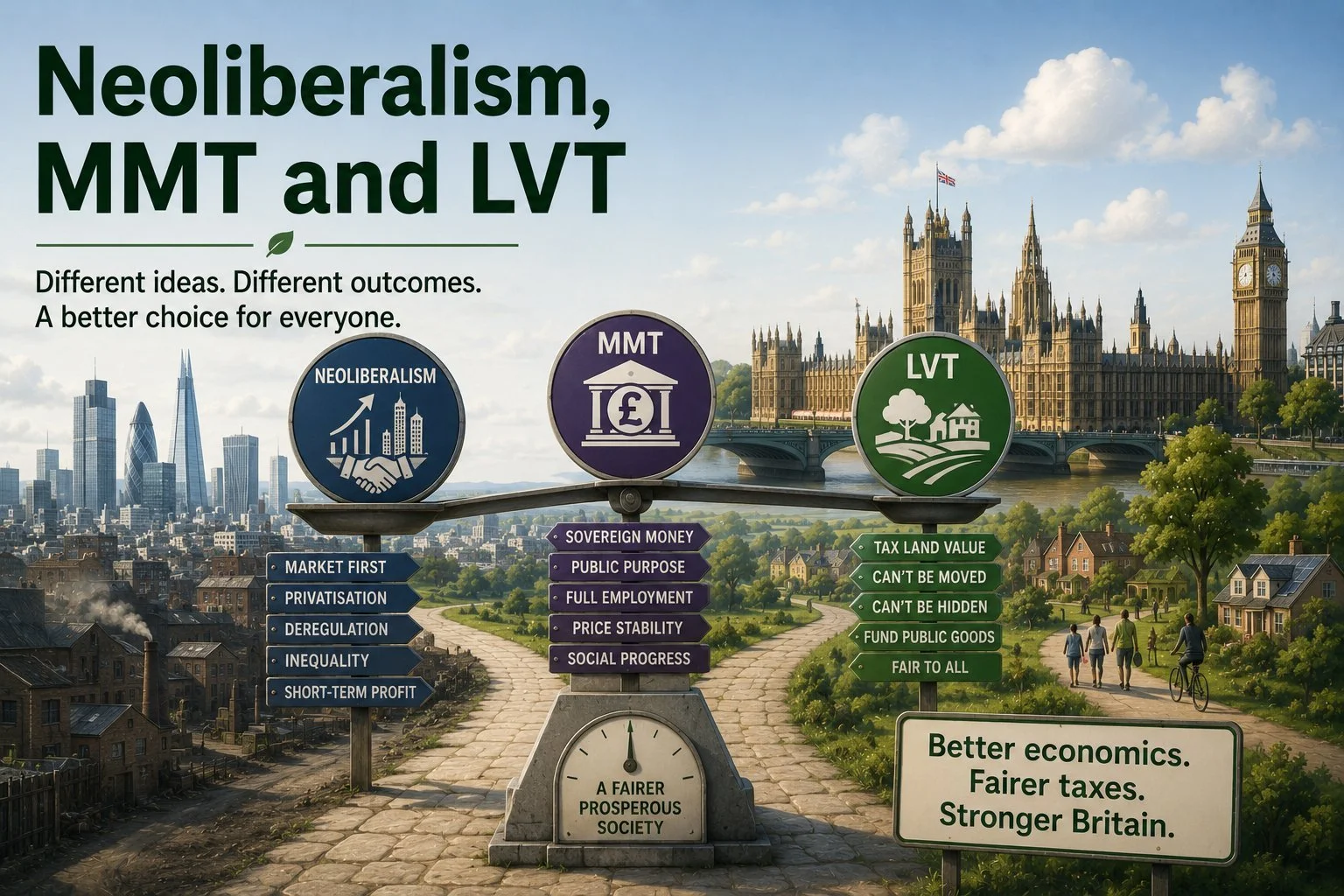
Neoliberalism, MMT and LVT
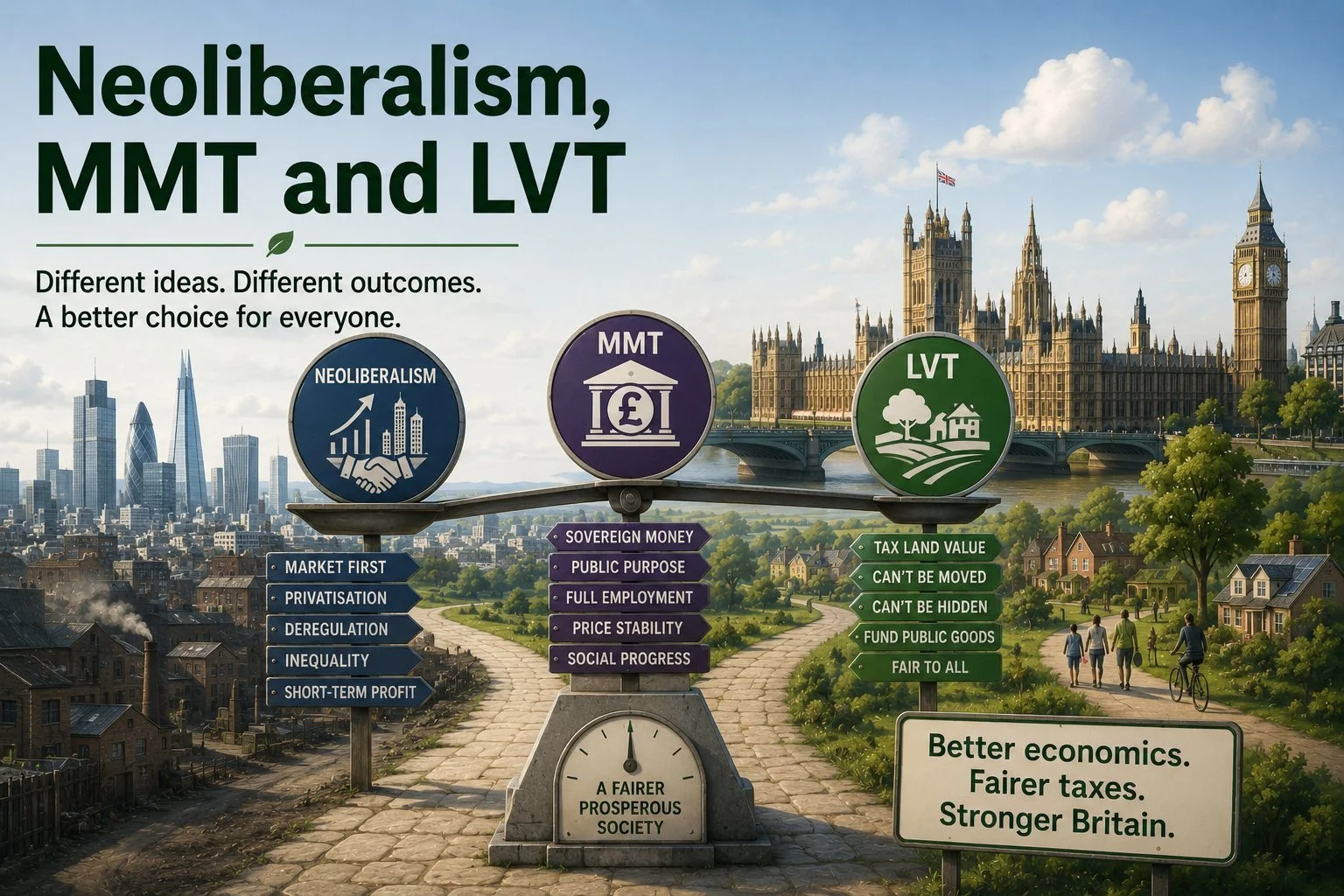
Neoliberalism and Modern Monetary Theory (MMT) are two ways of looking at how the economy works.
Neoliberalism
Neoliberalism has been with us for 40 years – since the Reagan/Thatcher era – and we see statements about it every day in the media and in parliament.
“Tax pays for things”
“No more taxes”
The economy should be run in the same way as people run their household budgets”
“Low taxes encourage enterprise”
“Government should follow tight fiscal rules” (See note 1)
“Government should intervene as little as possible”
“Deregulation allows enterprise to flourish”
“The bond market limits what government can do” (See note 2)
“Greed is good!” (See note 3)
“To fund something you have to take money from something else”
“Welfare spending should be cut to pay for things” (See note 4)
Private enterprise generates wealth”
“Rewarding enterprise allows money to trickle down”
“The market will decide”
“Public and nationalised services have no incentive to be efficient”
“Private companies are efficient in search of profit”
“Company growth is limited by minimum wages, employers’ taxes and workers’ rights”
“Global free trade forces companies to be competitive”
“Private Equity and Hedge Funds force companies to be efficient”
“The private sector, banks and the financial sector generate wealth”
“The private sector, banks and the financial sector can be trusted”
“People should fund their own social care”
“Compulsory health insurance would keep health spending under control”
Notes:
Rules are important for sport – they create a level playing field understood by all. The offside rule was introduced in 1863 and is understood by every player and every football fan.
There have been 10 different sets of fiscal rules since they were first introduced by the Labour Government in 1997 in order to pacify business, the City and the right wing press. The rules have been broken by every government since.. The Labour Party remains committed to neoliberalism and to the latest fiscal rules introduced by Rachel Reeves in 2024.
“The bond market” consists of those who wish to save with the government which cannot go broke (unlike banks) and always repays money saved with it.
The majority of trades on the bond market, like the majority of trades on the Stock Exchange, have nothing to do with “investment”. They are simply exchanging second hand bonds and share certificates for cash – they are betting on what will go up and what will go down. Less than 1% of trades purchase new bonds from government or provide real cash for companies to invest in R&D, manufacturing or marketing. The “Bond & Share Casino” would be a more fitting title.
Greed can turn people into unpleasant monsters like Trump and Musk. The sort of people who think: “I’ve done well, I am entitled to tell everyone else what to do!”
Even normal, pleasant people, who we can all admire, can find it hard to handle new-found wealth when they find themselves surrounding by parasites advising them on schemes to avoid taxes. Some of the worst offenders are still not in jail. Shoplifters stealing food can go to prison but you can steal millions from the government and still swan around on your yacht. Greedy people are unpleasant people.
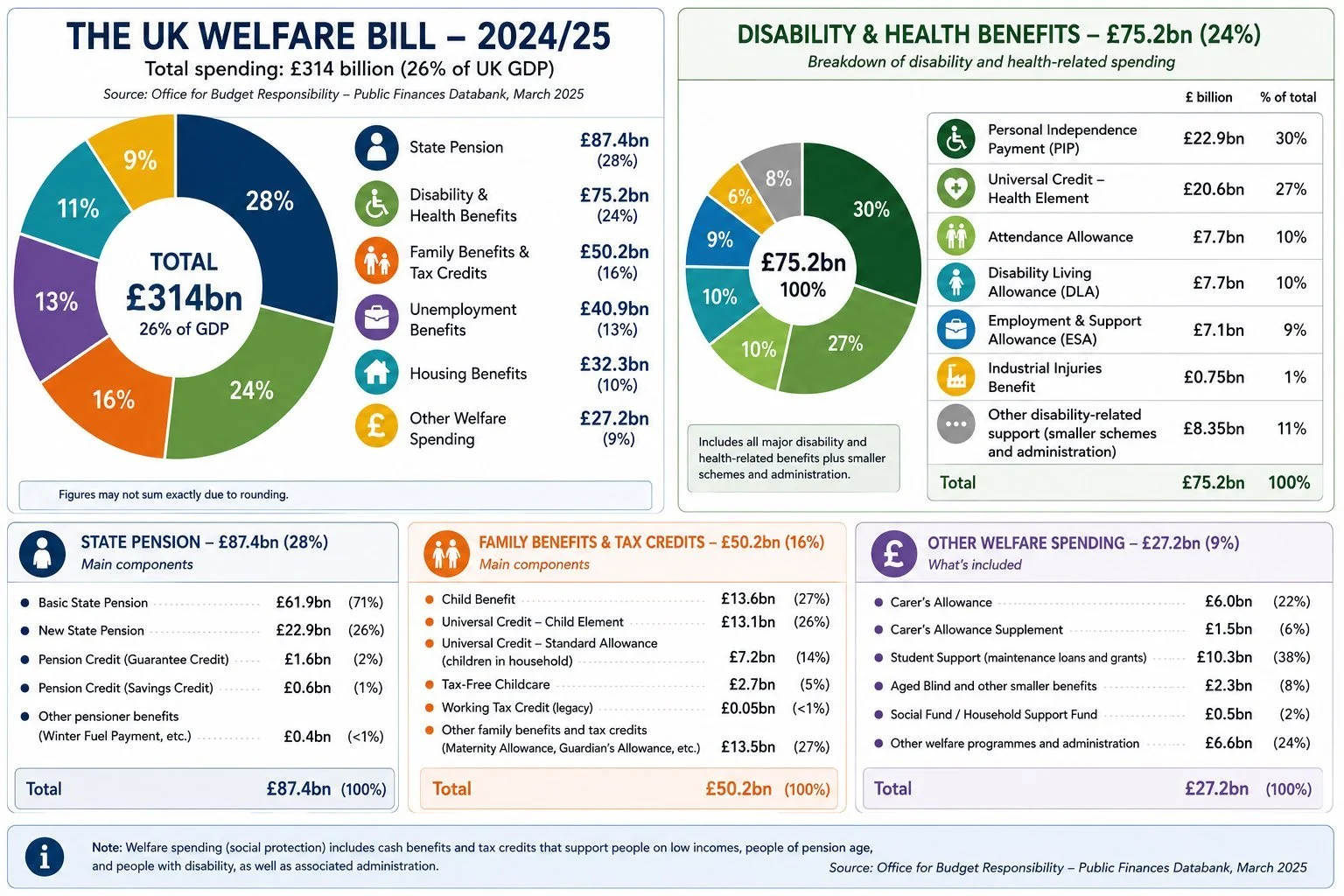
The media never lets facts stand in the way of a good story. Currently it is full of which parts of the welfare budget should be scrapped to pay for other things. Since the largest part of the welfare budget is pensions it is surprising that they don’t call for them to be scrapped. We wonder why? The facts are below.
Right click or press-and-hold on the image to open in a new tab or window.
The consequences of neoliberalism
We have tried neoliberalism for 40 years and it has failed. It has served the interests of oligarchs, presidents and billionaires while leaving the rest of us behind with:
high levels of personal borrowings (feeding the profits of banks and “the financial sector”)
the 2007/2008 financial crash brought about by greed, stupidity and reckless gambling by banks
National and local underinvestment has created a country that it is hard to be proud of – no wonder politicians look for scapegoats: “it’s the Russians”, “it’s immigrants”, “it’s the EU”, “it’s benefit scroungers”, “it’s those on disability benefit”. The biggest benefit scroungers are those who manage to evade and avoid their social responsibilities.
If something has failed, who don’t we try something else?
Awkward questions for neoliberalism
Two key points promoted by neoliberalism are:
the national economy should be run exactly like a household budget
“tax pays for things”.
At the end of WW2 the UK was broke. By 1946 It owed £2.2 billion to the USA and £1.19 billion to Canada (£123 billion and £67 billion in today’s terms.) These loans were not repaid until 2006. Similar loans from the USA to the Soviet Union were also repaid in 2006.
If “tax pays for things” how did the UK afford:
to partially nationalise the water industry in 1945?
to nationalise civil aviation (BOAC and BEA) in 1946?
to nationalise the mines in 1947?
to nationalise the railways in 1948?
to nationalise long-distance road haulage in 1948?
to nationalise electricity production in 1948?
to nationalise private hospitals in 1948?
to establish the welfare state in 1948?
to nationalise the gas industry in 1949?
to fully nationalise the water industry in 1973?
£127 billion to bail out the banks in 2008?
between £310 billion and £410 to cover the costs of COVID in 2020?
Did the government send a letter to taxpayers asking them to pay more to cover the cost of nationalisations?
No, it simply swapped private shares for long term fixed value government bonds paying interest of 3% per year. In many cases when the bonds reached their term it simply rolled them over until most were finally repaid in 2015. Because of inflation a fixed value bond for £100 in 1946 was worth about £2 in 2015 so it cost the government relatively little to pay them off.
We are now told that the country cannot afford to nationalise the water and other privatised industries despite their underperformance, environmental damage, massive CEO salaries and dividends going to overseas companies.
Modern Monetary Theory (MMT)
MMT is not a theory - it is a description of how the economy works in practice. It also shows how an economy can be run in the interests of society as a whole, not simply for private profit.
To avoid the nonsense about “well, it’s only theory!” perhaps it would be better to call it “Sovereign Economics” because it describes how a national economy really works.
the national economy is not run like a household. (See note 1)
tax does not pay for things. (See note 2)
government injects money into the economy to pay for things and to invest for the future.
money circulates within the private and public sectors of the economy. (See note 3)
too much money in circulation creates inflation.
the government uses taxes to drain off some money to keep inflation under contol. (See note 4)
the government doesn’t “borrow”, it provides a facility for those who wish to save their money securely. That’s why individuals save in National Savings and why pension funds, financial institutions and foreign governments save with the UK government by buying long term bonds. See the article “Debt? What debt?”
Notes:
Governments are supposed to govern, to be in control, to set the agenda, to ensure the economy functions in the interest of all citizens. Timidity does not make for good government. Households cannot generate money, they have to get it from somewhere. The government directly controls the supply of money for the economy.
If “tax pays for things” where does the money come from to pay taxes? Answer: like all money, it comes from the government which is the only thing that can create money. You may earn it by working, but it has to come from somewhere.
Government spending is huge. There is not a single business in the country that does not, in one way or another, rely on government spending. Teachers and nurses buy things – and are paid by government. Companies make weapons – paid for by government. Companies build schools – paid for by government. Companies build roads – paid for by government. The list is almost endless – without government spending the economy would collapse..
You can’t keep pouring money into the economy without risking inflation. The government therefore has to take money out of the economy using tax. The question then becomes: “which are the fairest taxes to use to take money out of the economy?”
Land Value Tax is the perfect tax for this because it is simple (you don’t need a lawyer to understand it), fair (those with the most, pay most) and impossible to avoid (unlike almost every other tax).
For those who prefer text rather than bullet points, the essay below compares the two and shows how LVT provides the fairest way to take money out of the economy through tax.
Please click here for a table comparing neoliberalism and MMT.
Neoliberalism
Click the image below for a larger version.

For more than forty years, economic policy in many developed countries has been dominated by neoliberal thinking. Lower taxes, deregulation, privatisation and reduced government intervention have been promoted as the best way to create prosperity. While this approach has undoubtedly encouraged innovation and increased global trade, it has also produced some unintended consequences. Perhaps the most significant have been the poor service offered by privatised utilities (water for example) and the widening gap between rich and poor, driven largely by rising asset values rather than increases in productive economic activity.
Neoliberal economics assumes that reducing taxes on wealth and business encourages investment, with benefits eventually "trickling down" throughout society. In practice, much of the additional wealth has accumulated in land, property and financial assets. Rising house prices, increasing land values and booming stock markets have benefited those who already owned substantial assets, while younger generations and lower-income households have found it increasingly difficult to accumulate wealth.
This concentration of wealth has several damaging effects. High property prices increase the cost of living, discourage productive investment and transfer increasing amounts of national income into rents and mortgage payments. Landowners often benefit from increases in land value created not by their own efforts but by public investment, population growth and planning decisions. A new railway station, school or business park can dramatically increase surrounding land values, yet these gains accrue almost entirely to private owners.
Anyone still believing that neoliberalism has been a great success (apart from for the wealthy) needs only step outside the front door and look around - if they can avoid the potholes. Either that or try to get an appointment with a GP.
Something is wrong, something doesn’t work - that something is neoliberal economics.
Modern Monetary Theory (MMT)
MMT isn’t really a “theory” - it simply describes how the economy really works - as shown below.
Click the image below for a larger version.

MMT offers a radically different view of how governments should manage their economies. Rather than treating government spending as something that must be funded primarily through taxation or borrowing, MMT argues that sovereign governments issuing their own currency can create money as required. The real limitation is not money itself but inflation. This shifts the debate from "How can government afford to spend?" to "How can government spend enough to achieve full employment without creating excessive inflation?"
MMT begins from a different premise. It argues that unemployment represents evidence that government spending is too low relative to the productive capacity of the economy. Rather than accepting unemployment as inevitable, governments should spend sufficiently to ensure that everyone willing to work can find employment. Such spending could finance infrastructure, scientific research, healthcare, education, environmental restoration and many other activities that improve national productivity.
Critics often argue that this would simply create inflation by printing money. MMT acknowledges this risk but argues that inflation - not government debt - is the true constraint on public spending. When an economy approaches full productive capacity, additional spending must be balanced by measures that reduce excess demand.
Traditionally, governments have relied upon higher interest rates to control inflation. Central banks increase borrowing costs, making mortgages, business investment and consumer loans more expensive. This reduces spending across the economy.
However, interest rate policy has significant drawbacks. It affects borrowers far more than wealthy asset owners. Young families with mortgages, businesses investing for growth and first-time buyers bear the burden, while individuals with large property portfolios or substantial savings may be relatively unaffected or may even benefit from higher interest income. The result is that one of the principal tools used to control inflation often increases wealth inequality.
Comparing the two and adding LVT
The contrast between these two approaches highlights one of the biggest challenges facing modern economies: how to encourage growth while ensuring that prosperity is shared more fairly.
Land Value Tax (LVT) offers an alternative that aligns perfectly with the principles of MMT.
Click the image below for a larger version.

Unlike taxes on income, profits or productive investment, a Land Value Tax falls only on the unimproved value of land. Buildings, machinery and business activity are not taxed. The tax captures part of the economic value created by society rather than by the landowner. Since the quantity of land is fixed, an LVT cannot discourage its production or drive investment overseas. Economists across the political spectrum have long recognised that it is among the least economically distortive forms of taxation.
Within an MMT framework, LVT could become one of the principal mechanisms for controlling inflation. As government spending stimulates economic activity, infrastructure improvements and stronger demand often increase land values. Rather than allowing these gains to accumulate entirely as private windfall profits, higher land values would automatically generate higher tax revenues. This withdraws purchasing power from the economy precisely where much of the inflationary pressure is emerging.
The distributional effects are equally important. Today, much of the wealth created by economic growth is reflected in rising land prices. Those who already own valuable land become wealthier without necessarily contributing additional productive effort. An effective Land Value Tax recycles part of these unearned gains back into public finances, allowing governments to reduce taxes on labour, enterprise and productive investment.
This changes economic incentives. Instead of rewarding speculation in land, the tax encourages owners to develop land efficiently or release it to those who will. Vacant sites become less attractive to hold indefinitely in anticipation of future price rises. Urban regeneration becomes easier, housing supply can increase and land prices may become more stable over the long term.
Government spending financed under MMT could therefore focus on investments that raise national productivity while the accompanying Land Value Tax moderates inflationary pressures and redistributes part of the resulting wealth. Infrastructure projects, education, healthcare and scientific innovation all increase the productive capacity of the economy. As these investments enhance surrounding land values, part of that publicly created wealth is automatically returned to the public purse.
No economic system is perfect. Neoliberal policies have delivered greater efficiency in many sectors but have also contributed to rising inequality and an over-reliance on asset appreciation as the primary source of wealth. MMT offers a more active role for government but requires credible mechanisms to prevent inflation and maintain confidence in the currency.
A well-designed Land Value Tax could provide one of those mechanisms. By taxing economic rent rather than productive effort, it simultaneously discourages speculation, moderates inflationary pressures, captures publicly created land value and supports a fairer distribution of wealth. In combination with carefully targeted government investment, it offers a coherent framework for achieving both sustained economic growth and greater economic fairness - an outcome that neither traditional neoliberalism nor conventional monetary policy has consistently succeeded in delivering.