Who owns Britain?
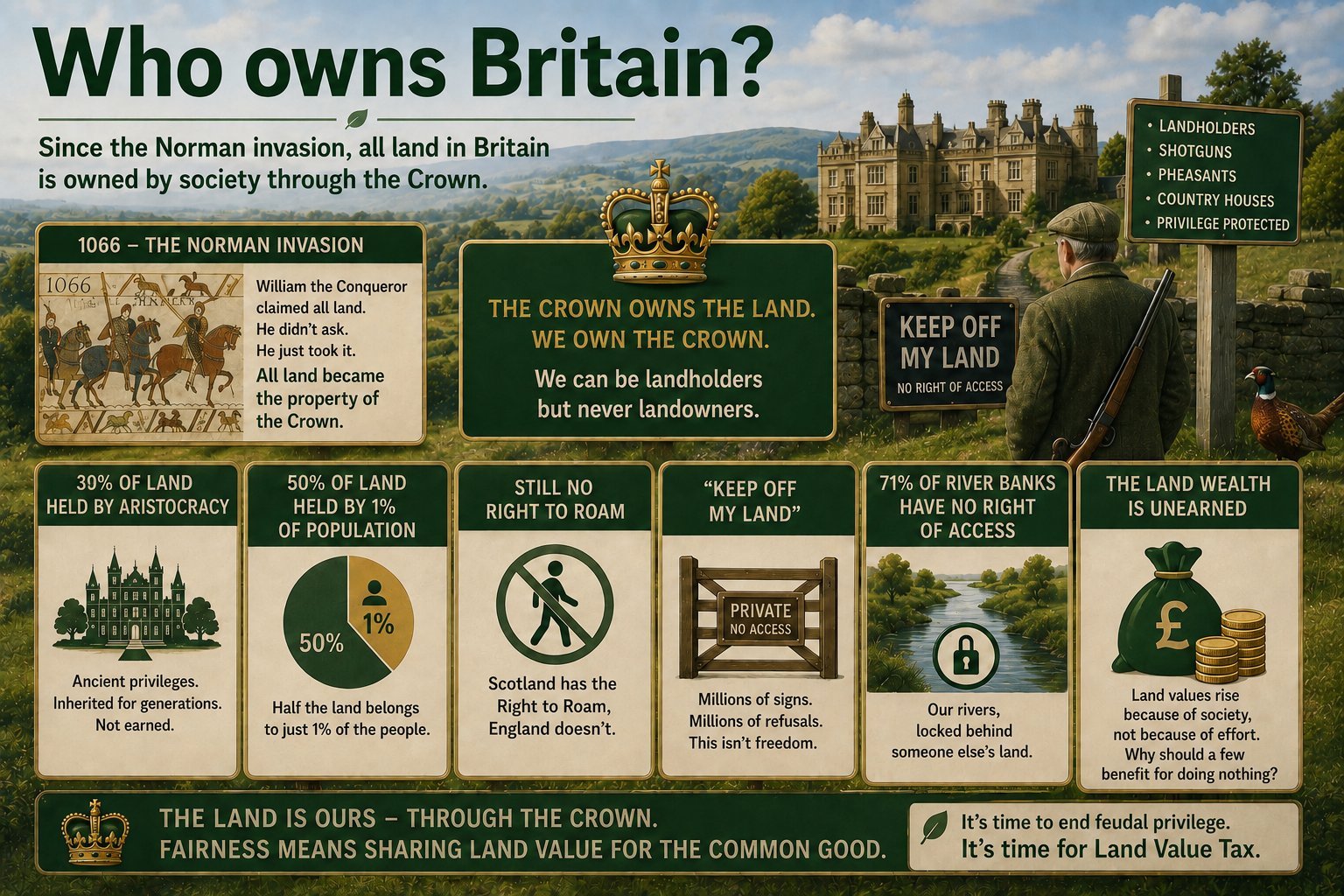
We do!
As a society we own all the land in the country - through the “crown”.
You can purchase the right to “hold” land (“freehold”) but you become a landholder, not a landowner. You “own” everything on the land (buildings, gardens etc.) but you “hold” the land itself. People often confuse the two but the difference is vitally important because we own the land so we should benefit from its use through Land Value Tax.
The landholder in the video below has confused landholding with landowning and, like landholders before him, is happy to turn to violence to defend it. He also misunderstands laws relating to trespass - there are some excellent books on the subject.
How did this come about?
When investigating history the golden rules are “follow the money” and “who wrote it?”
In fact, almost all of history is about the right to extract rent and resources from land. that’s why wars were fought and why they are still being fought today. These days it is rarely the offspring of landholders, oligarchs, billionaires, presidents and politicians who do the fighting! Throughout history, tenants, and those who work for a living, have fought for the rights of their landlords and employers.
In AD43 the Romans invaded England. For almost 400 years they extracted raw materials (gold, copper, tin, lead etc.), created vast agricultural estates and took tens of thousands of Britons as slaves.
The Romans left in AD410.
In 1066 the Norman French invaded England. They stole all the land and made it the personal property of the king to share (as “holdings”) to those who supported him so they could live off rent. The land was confiscated if they rebelled.
The Norman French never left, they are still here.
Their descendants still hold 30% of our land. Two examples are the Grosvenors (Dukes of Westminster) and the Cavendishes (Dukes of Devonshire).
The Norman French controlled the military and wrote the laws to defend their land – which is why we have the concept of a “trust” - a pretence that land is not held by a person or family but by an inanimate object, a piece of paper called a “Trust Deed” - all designed to avoid tax and hold land together. Trusts should be abolished and converted into companies with the trustees as directors and the beneficiaries as shareholders - then we will know who holds what and make them pay their fair share of tax.
The aristocracy and the church
Norman Dukes, Marquesses, Earls, Viscounts and Barons held the land but they, like most of the population, lived in fear for their souls.
The Christian Church (Catholic before 1534, Anglican afterwards) offered a free ticket to heaven. After 1066 the major beneficiary of William of Normandy’s largesse was his half brother, Odo, Bishop of Bayeux, who became Earl of Kent. Odo was a “warrior bishop” and, like William, was motivated by greed, fighting for land and rent, and, with land in over 23 counties, he became the second largest landholder after the king himself. He was involved in multiple violent episodes caused by his greed, including a plot to invade of Italy in an attempt to become pope and a rebellion in 1087 in England when he supported the wrong side after William’s death, He died in Palermo in Sicily while on the way to seize more land in the Holy Land as part of the first crusade.
For almost 1,000 years the Christian church has remained important for keeping people in their place: “why use the sword when you can threaten them with hellfire and damnation!”
During the first 500 years the Church increased its share of land in England until 1536 when Henry VIII dissolved the monasteries and sold church land to those willing to pay for it.
In a typical Norman landholding family the first son became the heir (to make sure land stayed within the family) , the second entered the military (to physically protect land), the third became a lawyer or MP (to write laws to protect land) and the fourth became the local priest (the “Rector”) to extract tithes from those who worked the land.
Apart from in the South East, which gave in fairly quickly, rebellions against the Normans continued for decades - they had to build over 500 motte and bailey castles, initially wooden then stone, from which they could ride out to collect rent and crush rebellion. A major rebellion of 1069 resulted in the “Harrying of the North” when tens of thousands were killed, villages and towns were burnt to the ground and the land laid to waste.
The Normans did not seize full control of England and Wales until the building of Caernarfon Castle in 1283 by Edward 1st.

Interpreting history
There are two guidelines when interpreting history:
Follow the money! This is good advice to anyone trying to understand history - find out who benefitted financially.
Who wrote it? What was the background of the author? What picture were they trying to paint? What is their bias? History is usually written by the victors.
English history is full of rebellions against the system created by Norman landholders, their descendants and those who have acquired land in different ways. Henry VIII created new landholders by selling off church land and the English Civil War did the same. Oliver Cromwell, himself a landholder at the start of the war, gained even more land after it ended.
Rebellions are often overlooked when history is taught in our schools. The Great Revolt of 1381, if it is taught at all, is often described as “The Peasants Revolt” when most of those who fought were certainly not peasants! Anyone educated in a public school, or in a state school earlier than the last few decades, is unlikely to have heard of most revolts – and there are dozens, if not hundreds of them, all ruthlessly put down in the interests of landholders.
Have we moved on?
In the 2020s, following on from 1066, we still have kings, dukes, marquesses, earls, counts, viscounts, barons, baronets and knights. The aristocracy still holds over 30% of our land.
Following on from Bishop Odo, by the 2020s the majority of the population has turned against religion. Among young people 71% of 18 to 24 year olds said they had no religion, only 2% said they were CofE and only 37% want Britain to remain a monarchy.
Twenty six unelected bishops, representing the 0.9% of the population that attends C of E services, sit in the House of Lords pontificating about our laws yet our system of representation means that most people do not have their views heard in parliament. Less than 21% of the electorate voted for the Labour Party in 2024.
No government has ever secured the support of the majority of the electorate.
But this was 1,000 years ago, things are different today!
There are over 15,000 people in England who are older than 100 and just ten of those lifetimes take you back to 1066 - so, it's not that long ago!
It's not William and Odo we are concerned about, it is the social structure that has been developed since the start of the Norman occupation. Our legal system (the most complex in the world) developed to protect property and wealth and our education system developed to train the sons and daughters of landholders to make and defend the law.
There is no tax on land.
In England today many (most?) large landholdings are in the name of a company or trust to avoid tax. In some cases, those companies and trusts are registered in tax havens to further avoid tax. In some cases (Chatsworth for example) trusts have become charities to benefit from tax-free income.
Legitimising the theft
If you have seized land through violence you need to legitimise your ownership (after all, you are not a common criminal, you used a sword not a jemmy) so you need to change the law, or create a new legal system, and you need to enforce that law through a judiciary (recruited from your social class) backed up by the threat of further violence (using an army led by your social class).
In the 2020s in England 83% of the population is urban while 17% is rural - only 301,000 people work in agriculture but the Norman occupation is glaringly obvious in the countryside. Many large estates still remain in the hands of Norman descendants and most others have passed through very few hands since 1066. Hundreds of aristocratic and upper middle class families still send their children to public schools and live extremely well from rent taken from land seized through violence.
“Why work when you can live off rent and pass it on, tax free, on a silver spoon?”

Gerald Grosvenor, Duke of Westminster, was asked for advice on how to get on in the world, his reply was telling:
“have an ancestor who was good friends with William the Conqueror.”
His son, Hugh, the current Duke, is now worth £9.42 billion.
Screaming out for reform
Our landholding laws are impenetrably complex - that's why lawyers love them! There are times when the best way to solve a problem is to scrap things and start again - and this is certainly the case with laws relating to land and property.
There are about 15,000 solicitors and conveyancers involved in the residential property transaction business and they make over £2.5 billion a year.
Think how much society would benefit if all that well-educated brain power was put to better use. Think how much money we would have every year to spend on other things - like 2,500 new medical centres for GPs..
The average house in England is £291,000. The price of a Bentley Continental is £324, 560 – if you could afford it! You can sell the car by giving the buyer the V5 and then notifying DVLA. Job done and no lawyers involved. Why can’t we do the same with a house?
William of Normandy did it in 1066, we can do it now!