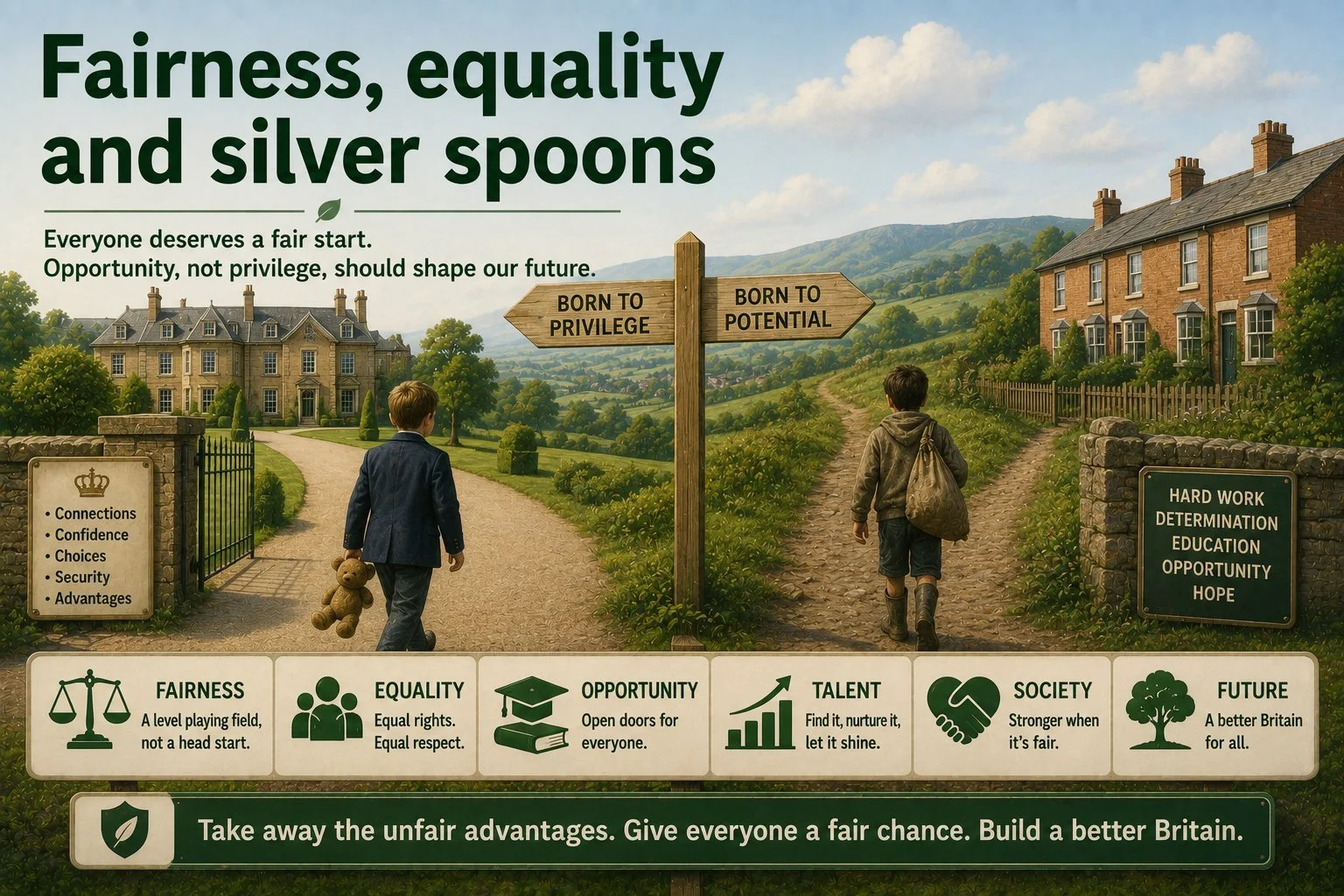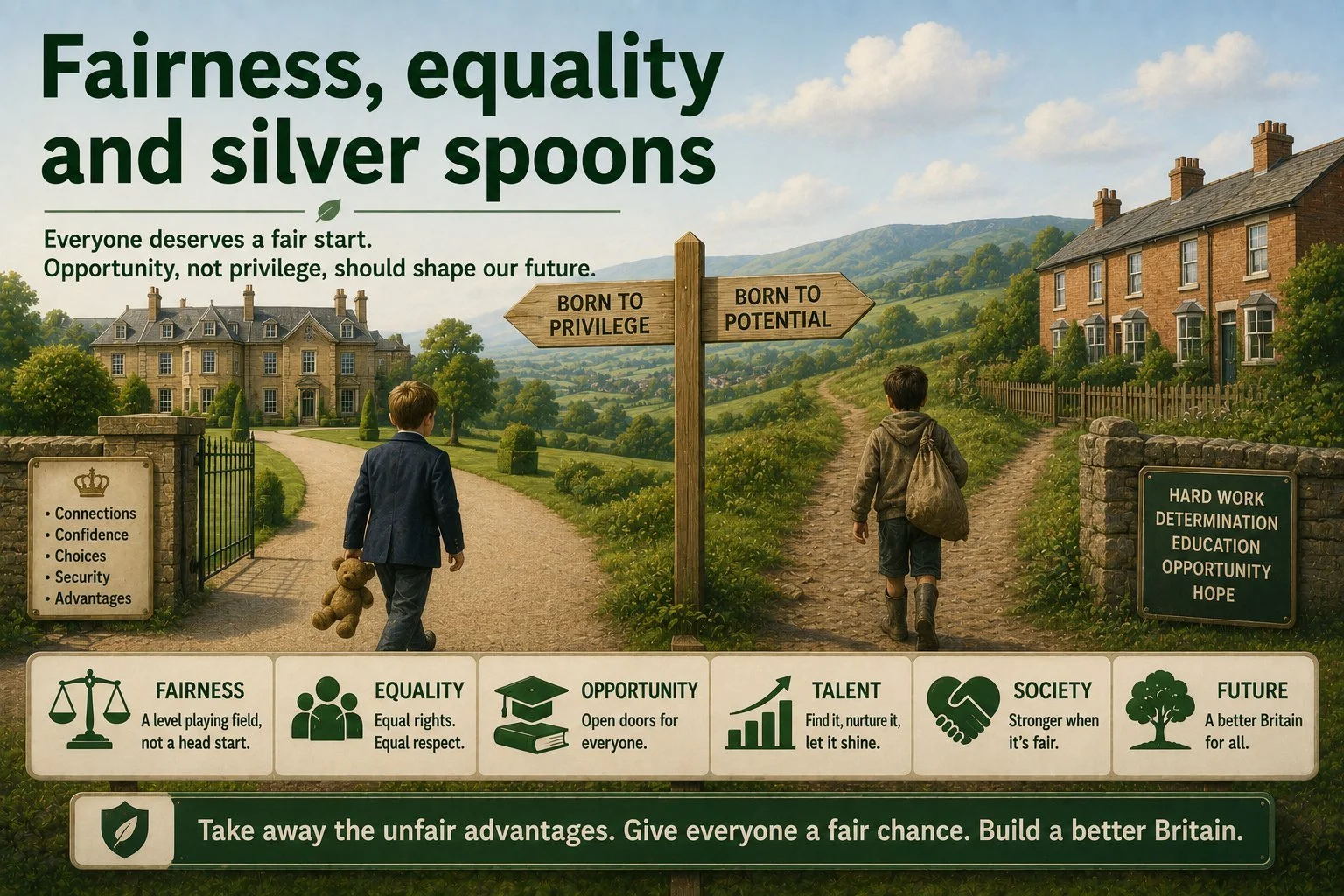
"The desire for a fairer society has always been driven by a sense of injustice. When thoughtful people recognise that something is fundamentally unfair, they begin to ask how it can be changed."
This page was written by one of the contributors to the site.
The central theme of this page is that people can do well and become wealthy because of what they do – not because of what their parents were.
The idea of a level playing field, where we each stand an equal chance of succeeding, is understood by everyone but is far from the reality of life.
Background
The author of this page came from a rural background, living in an ancient water mill with no electricity, no gas, no central heating (icicles on the inside of bedroom windows!), no mains water (we had a manual stand pump over a well), no mains sewerage and a chemical toilet half way down the garden. Light was a Tilly, heat was an open fire and cooking was a coal fired stove. (Note: this was the second half of the 20th century, not the 19th!)
We are not born “equal”, we are born “different”. Some are tall, some are short; some enjoy good health, others don’t; some are bright, others aren’t; some have loving parents, others don’t.
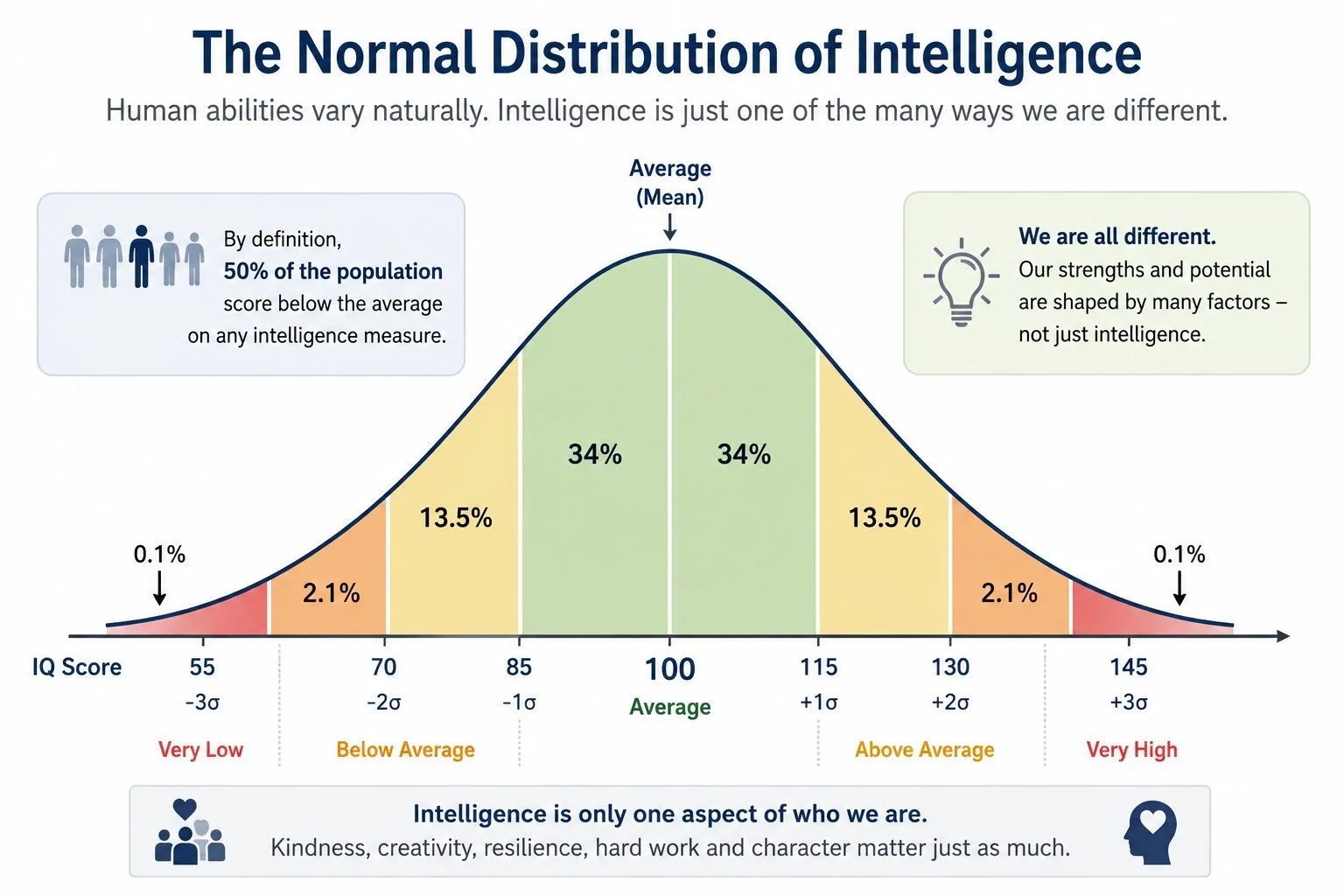
The normal distribution, the “bell curve”, applies to many of the variables that make us different. For example, 50% of the population is below average intelligence – and 50% is above. I was lucky, I was in the second group, I was bright and I had a decent state-funded education through primary, secondary and tertiary education – I left university with money in my pocket thanks to a full grant from my Local Authority.
After University I spent a short time working for Rolls Royce before teaching in a primary school. I then co-developed a word processing package (before Microsoft Word!), and set up a software company. I continued to invent new software and hardware products while building companies (funded from income, not borrowings) and employing people. I also paid all my company and personal taxes with no attempt to avoid my social responsibilities. I enjoyed my career and I can look at myself in the mirror and feel happy in my own skin.
There are other words that should go with “fairness” and “equality” – I think “honesty”, “trust”, “reliability”, “empathy” and “open-mindedness” are some of them. I have no time for liars, cheats, crooks, back-stabbers, chancers, sycophants, bigots, hypocrites and the overtly greedy. Greed can turn pleasant people into highly unpleasant people.
I believe everyone deserves dignity and an opportunity in life. I believe that creativity, enterprise and hard work should be rewarded. I also believe that, as well as being responsible for our own lives, we have responsibilities towards society by paying our taxes. I think that taxes on earned income (from personal work) should be lower than unearned income (gifts, rent etc.).
To make it clear: I am not against wealth (when earned), entrepreneurship, investment (*), parents helping their children or footballers and “celebrities” making millions.
* note: “investment” means putting money directly into businesses. It does not mean swapping existing shares. The secondary market (swapping shares for money) is gambling and represents 99% of Stock Market activity while contributing nothing to companies for R&D, manufacturing, marketing and growth. It does, however, contribute to the profits of banks and the bonuses of “the financial sector”.
Why?
Why should someone enjoy enormous advantages simply because they happened to be born into one family rather than another?
How can we compare those who earn their income by taking risks, by enterprise, by creating jobs, by developing new products, by building companies, by creativity, by working hard and by contributing to society, with those whose wealth requires no effort, no innovation, no risk and no contribution to society?
Why do those in the first group pay more tax than those in the second in proportion to their incomes? Why do those in the second group go out of their way to find schemes or tax havens to avoid tax?
Why do we tax unearned income less than we tax earned income?
Inheritance tax is the wrong answer!
Inheritance tax is flawed:
it encourages avoidance,
it is complex,
it is very unpopular,
it distorts behaviour (giving things away seven or more years before death),
it taxes estates rather then beneficiaries,
it encourages expensive legal planning – it makes money for lawyers,
it uses “trusts” – a pretence that a piece of paper, a “trust deed”, “owns” things tax-free.
A better solution
Scrap inheritance tax.
Introduce a tax-free Lifetime Gift Allowance (LGA) for each of us – revised annually and set to twice the national average house price which, in August, 2026, was about £300,000 so the LGA would be £600,000
Once the lifetime allowance is used up any further income is taxed as unearned income.
This:
is simple,
is transparent,
is difficult to avoid,
treats all gifts equally,
allows parents the freedom to leave wealth to their children,
ensures that those who benefit contribute fairly by way of tax.
LGA doesn’t prevent anyone receiving any amount from a will - it does not confiscate an inheritance!
If your parents leave you £20 million you will pay tax on £19,400,000 (assuming you have not used up your £600,000 LGA). The top rate of tax is 45% so you will receive £10,670,000 plus the £600,000 allowance. £11,270,000 in your pocket after tax is not bad for simply being born!
Double taxation? Nonsense!
Those opposed to LGA will argue that this is double taxation because your parents will have already paid tax on their income before leaving it to you. This is nonsense.
When you pay a plumber to install new radiators that plumber will be taxed on that income - which you have already paid tax on. This is not double taxation, this is the way the system has always worked.
Think of it this way. Your parents paid tax on income they earned - and they can do what they like with it - pay plumbers or leave it to you. It is only fair that you pay tax on income you didn’t earn.
Why this is morally fair
A child does not choose:
its parents,
its wealth,
its social class,
its post code,
its education.
Society cannot eliminate every inequality but it can reduce the influence of inherited privilege.
The aim is not equal wealth.
The aim is a fair start.
Equality vs equality of opportunity
We are not the same, we differ enormously:
different talents,
different ambitions,
different work ethic,
different health,
different luck.
A fair society does not guarantee equal success.
It guarantees that success is determined as far as possible by what people do, not by who their parents were.
This is not envy
I have done well in life and I have no resentment towards successful people.
My concern is not that some people become rich, it is that some people become permanently privileged without contributing anything.
To be honest, I am angry that our society has been developed to favour those who live off those who work.
Taxes are important
Taxes are not punishment. They allow the government to invest in:
education,
healthcare,
transport,
justice,
defence,
scientific research,
opportunity,.
No successful person succeeds entirely alone, we each benefit from the society built by previous generations and from the investments of previous governments.
Why this matters for the country
Are we making the best use of talent?
How many inventors never become inventors?
How many entrepreneurs never get started?
How many children never realise their potential?
Inherited privilege wastes human potential.
The aim is not to pull successful people down.
The aim is to lift everyone up and to create a country where:
success is admired,
enterprise is rewarded,
inherited privilege is moderated,
everyone contributes,
everyone has a genuine chance..
Silver spoons
“Hard work, sir, I can respect, but only cads and bounders demand respect by virtue of being born.”
Silver spoons come in two forms.
Old money usually has vast estates - some stretching back to the beginning of the Norman occupation in 1066. Old money has enough money to ensure it can pass wealth from one generation to the next without paying tax. Old money tends to keep a low profile and avoids bling. Old money would not be seen dead engaging in the “mine’s bigger than yours” competition for superyachts!
New money is rather less subtle in its ostentation.
Politicians are in awe and fear of both old and new money (because money buys undue influence in our society) and some of them go on to compete in the wealth stakes.
You’re just jealous!
No, we are just angry!
We are angry with those who go our of their way to avoid contributing to society.
We are angry with those who attempt to hide their wealth in tax havens.
We are angry that those with wealth employ clever (and expensive) tax avoidance advisors while those on PAYE don’t. We want to make tax avoidance advisors redundant!
We are angry with tax avoidance advisors who promote schemes to avoid tax.
We are quite happy for people to enjoy the benefits of their own inventiveness, creativity and effort. We draw the line when they try every trick in the book to avoid their social responsibilities.
We get annoyed when some of the richest people in the country have the brass neck to complain when a government attempts to put an end to their deliberate tax avoidance.
Creating a level playing field
Reforming our tax system is the simplest way to create a level playing field.
Government injects money into the economy (the Government is the only thing that can create money) by paying for the things we need and by investing in the future.
Government uses taxes to drain money out of the economy to prevent inflation.
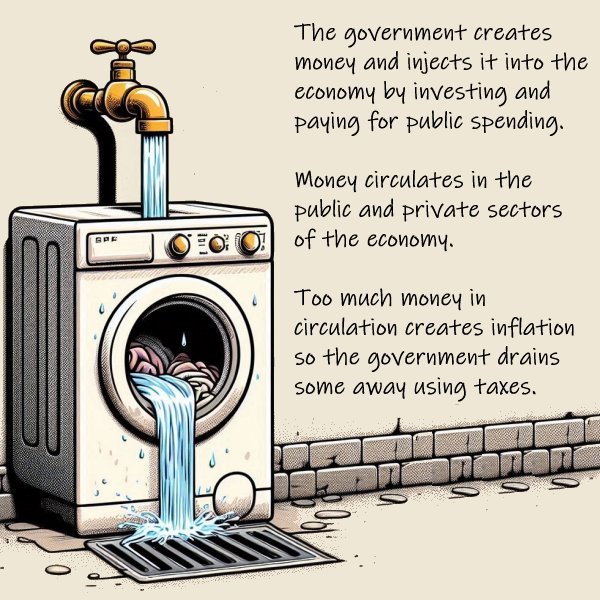
It doesn’t really matter which taxes are used, as long as money is taken out of circulation.
It therefore seems reasonable that taxes should be fair by taking the same proportion from those with the most as from those with the least.
Scrapping inheritance tax, introducing a Lifetime Gift Allowance and introducing Land Value Tax will be major steps towards creating a fairer society.