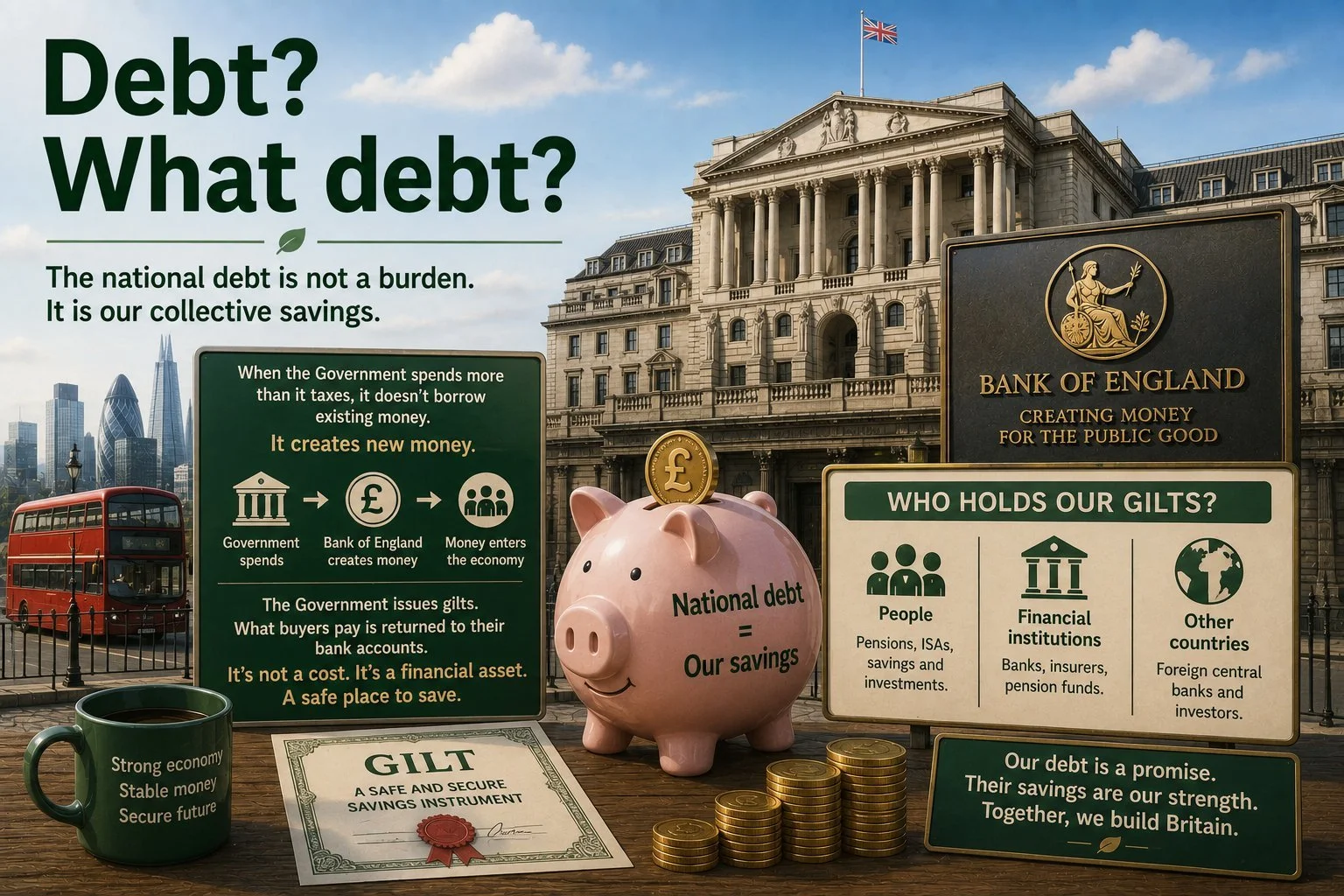
Debt? What debt?
This article was written by one of our contributors who has retired from running his software company.
Almost every day we are told that there are “black holes” in the government’s spending, that the “National Debt” is out of control and should be repaid or that the Chancellor is “at the mercy of the bond markets”.
Most of this comes from those promoting more austerity, more “belt tightening”, more cuts to services, more cuts to benefits and, of course, absolutely no tax increases! It usually comes from those who register their companies and personal financial affairs in tax havens outside the UK to avoid paying tax at all! For example, the Daily Mail is owned by companies in tax havens on behalf of Jonathan Harmsworth (“Lord Rothermere”) who is “not resident in the UK for tax purposes” despite having his UK residence at Ferne Park in Wiltshire.
Much of what is said is nonsense resulting from treating the national economy as if it was a household budget! This article covers economic views in more detail.
In mid September 2023 I decided to tidy up my savings and moved some cash into fixed term bonds with a couple of banks and building societies – paying around 5%. I then spotted that National Savings Issue 72 was offering 6.2% so I put £100,000 into a one year bond.
I contacted my SIPP (Self Invested Pension Plan) provider and asked them to move a significant amount into a similar bond. Unfortunately they were slow off the mark and notified me on October 5th that the bond was no longer available.
Over 225,000 people did the same as me – they put their savings into Issue 72 which raised £11.3 billion before the offer was withdrawn. Government bonds (savings) are offered as required – they are withdrawn as soon as enough is raised.
National Savings is the government. Issue 72 was withdrawn by the government as soon as it had raised enough.
£14 billion gone in less than an hour!
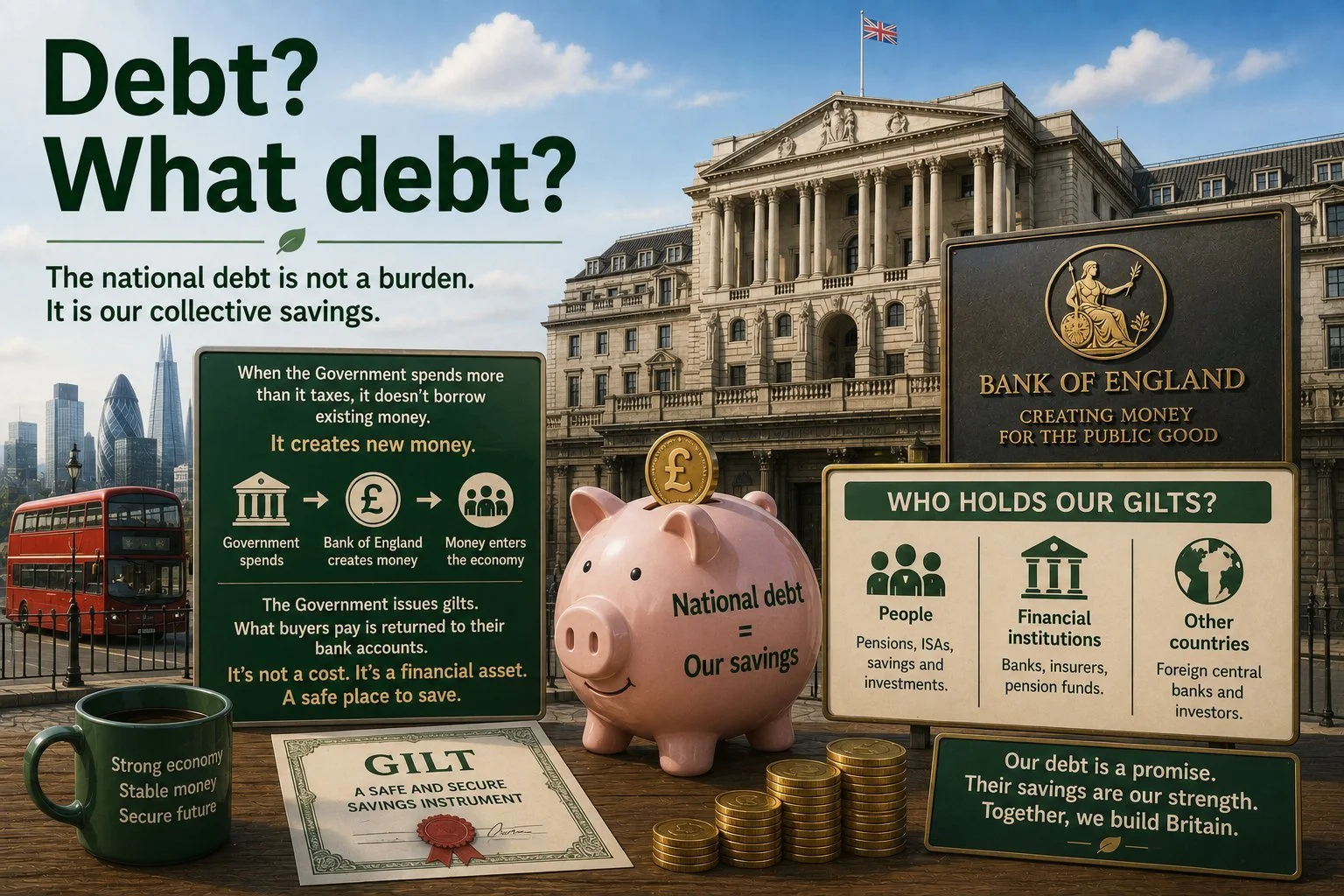
At 08:30 on September 2nd, 2025, the government offered a 10 year bond (known in the City as a “gilt”) paying 4.75%. At 09:30 (on the same day!) the government closed the offer because it wished to raise £14 billion and it had received offers of over £140 billion. Those applying for the bond got, on average, 10% of what they requested. Those making the offers were primarily financial institutions including banks and pension funds.
The gilt issue was handled by the United Kingdom Debt Management Office.
It seems that savers like me (and banks and pension funds) are only too happy to save with the government because we know our savings are secure. The same could not be said about savings in banks in 2007/2008 when greedy bankers brought the world to its financial knees and had to be bailed out by the rest of us.
So, the government provides a secure way for us all to save. In fact, without this willingness of the government to accept savings, the financial world would collapse! (Ask a banker!)
So what is the National Debt?
“The National Debt” should be renamed as “The National Piggy Bank”!. It represents savings, not debt. Do we talk about Nationwide Building Society’s “debt”? No, we talk about the amount of money saved with it (about £370 billion in July, 2026). Does the Nationwide need to repay its debt? No, savers are happy to leave their money with it - unless it does something silly (like investing in sub-prime mortgages in the USA) and there is a run on the bank - as there was with Northern Rock Bank in 2007 when it was saved by the Bank Of England. The same reckless financial gambling brought down the Derbyshire Building Society in 2008 when it had to be taken over by the Nationwide after some arm twisting by the Government.
The National Debt is the amount of money that people, banks, pensions funds, and other countries have saved with the UK government. For example, the USA has saved about £78 billion with the UK government and China has saved about £600 million.
There can never be a run on the government. Firstly because the government can always pay its debts and secondly because the savings are in the form of term bonds – you can’t walk in and demand your money back as you can with a current account at a bank.
99% of “the bond market” is gambling with second-hand bonds. Less than 1% is putting money into government bonds. This is the same as the Stock Market – less than 1% of the trades actually generate money for companies, the rest is a secondary gambling – trading in second-hand shares.
The bond market and the Stock Exchange contribute nothing to the UK economy outside the very few occasions (<1% of all trades) when they genuinely provide new capital when government or companies issue bonds or shares. 99% of the time they exist only as a gambling casino and, like all casinos, for every winner there is a loser – but the house always wins! They claim to offer “liquidity”, enabling share owners to sell and buy shares as they wish. However, this, in itself, provides nothing for companies and nothing for growth - it simply swills money around, making nothing (except fees for “the financial sector”). They provide nothing significant for the social good.
Why do people, institutions and foreign governments save with the UK? Because they know it is 100% secure - unlike money in private banks - as we found out on 2007/2008.
Interest has to be paid on these savings and, eventually, they have to be paid back. I rolled my Issue 72 savings into Issue 81R at 4.75% so I am still saving with the government. Do I want the government to pay back my savings? No, not at the moment. That applies to most of those who save with the UK government- they want their money looked after securely.
The government uses the savings to invest and cover its costs – building hospitals, building schools, paying doctors, paying nurses, paying teachers, building missiles etc. This is the same as most medium to large companies who finance major investments by issuing more shares or by borrowing.
The government pays the interest on savings, and the capital returns, through taxation.
In fact, as a higher rate tax payer, the 6% interest I got from Issue 72 was really 3.6% after 40% income tax and no doubt more has gone back to the government through VAT, fuel duty, alcohol duty etc.
Are people reluctant to save with the UK government?
No.
There are plenty of people and countries willing to save with the UK government – that’s why the 10 year gilt, on offer between 08:30 and 09:30 on September 2nd, 2025, went so quickly - and why it was ten times oversubscribed.
The time to start worrying is when savers refuse to save! However, that is never going to happen because countries like the UK are not households, they can be relied upon to always pay back the money saved with them – with interest!
The UK can’t go broke - no matter what the tax-avoiding Daily Mail would like you to believe.
Should the debt be repaid?
NatWest holds over £738 billion in assets. (Savings etc.)
Barclays holds over £1.5 trillion in assets (Savings etc.)
Lloyds holds over £1.3 trillion is assets (Savings etc.)
Nationwide holds over £382 billion is assets (Savings etc.)
The total assets of UK banks and building societies is about £7 trillion.
The total held in the national piggy bank (“the National Debt”) is about £3 trillion.
Are these bad things?
Should they all be repaid?
Why?
The economy would grind to a halt if we had nowhere to store our savings.
The economy would grind to a halt If the government didn’t pay for things and invest.
Why should the “National Debt” (our national piggy bank for savings) be repaid?
What guarantee do you have if a bank goes broke? (You lose everything over £120,.000).
What guarantee do you have for your money in the national piggy bank? Your money is 100% secure – the government has never gone broke and can never go broke – unlike banks.
Those who lost trust in banks after 2007/2008 need a Citizen’s Bank.